
India and China on Thursday vowed to redouble efforts to resolve the remaining issues in eastern Ladakh at the earliest and 'stabilise and rebuild' ties even as External Affairs Minister S Jaishankar conveyed to his Chinese counterpart Wang Yi during a meeting that the Line of Actual Control (LAC) must be respected.

However, the details of the meeting were not officially confirmed.
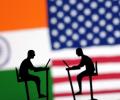
Commerce and Industry Minister Piyush Goyal on Tuesday expressed hope that India will conclude the proposed bilateral trade agreement (BTA) with the US by the fall or November this year. He said that "a little bit" of geopolitical issues overtook the trade matters in the negotiations for the pact between the two countries.

India and Pakistan exchanged lists of their nuclear installations on Wednesday, fulfilling a decades-old agreement that prohibits attacks on each other's atomic facilities. The exchange took place amid strained relations between the two countries over the Kashmir issue and cross-border terrorism. The agreement, signed in 1988, mandates the annual exchange of such lists, which has occurred for the 34th consecutive year.
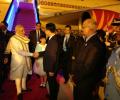
"Hello Hangzhou! PM lands in China to attend the G20 Summit," Modi tweeted.

A video shows that Shehbaz was asking an aide for help, however even after the aide's assistance, his headphones dropped once again.

Russian Foreign Minister Sergey Lavrov and Defence Minister Sergey Shoigu will visit India to hold the inaugural '2+2' ministerial dialogue between the two countries on December 6, the Russian embassy has said.

Uzbek President Shavkat Mirziyoyev chaired the 22nd SCO summit in Samarkand which was attended by Prime Minister Narendra Modi.
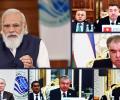
The Shanghai Cooperation Organisation (SCO) will hold its first in-person summit in Samarkand in Uzbekistan on Thursday after two years, shaking off Covid fears and providing a rare opportunity for all its eight heads of state to meet on the sidelines of the event to have face-to-face talks on pressing global and regional issues of common concern.
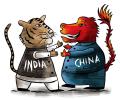
India and China have announced a series of measures aimed at improving their relationship, including maintaining peace along the border, reopening border trade, and resuming direct flights.

The Shanghai Cooperation Organisation is very much aligned with the foreign policy priorities of the Modi 2.0 government, says Sana Hashmi.

Disengagement from the LAC will remain a chimera because China has given enough indications that the PLA will not move back any more. China has even deployed drones to monitor and deny any patrolling by Indian troops even in the buffer zones which are all in Indian Territory, explains Lieutenant General Prakash Katoch (retd).

Russian Defence Minister Sergei Shoigu and his counterparts from Uzbekistan and Kyrgyzstan are also attending the meeting to be chaired by Rajnath Singh.
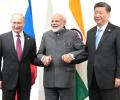
It will be Putin's first participation in a multilateral summit after a mercenary group launched a short-lived armed rebellion last week that rocked Moscow.

'India needs to be cautious that its differences with Pakistan do not obstruct SCO's functioning,' says Sana Hashmi.

The two leaders, who will be present in Ufa to attend the SCO summit, will be meeting on the sidelines of it.
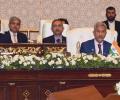
Delivering a thinly veiled message to Pakistan from its soil, External Affairs Minister S Jaishankar on Wednesday said activities across borders characterised by the 'three evils' of terrorism, extremism and separatism are unlikely to encourage trade, energy flows and connectivity.
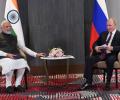
The phone conversation came days after it emerged that Modi will not be travelling to Russia for the annual India-Russia summit this year.
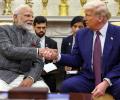
A US lawmaker and former officials warn that President Trump's policies are damaging the strategic partnership between the United States and India, potentially driving India closer to China and Russia.
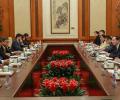
In the talks, China emphasised that the two sides should proceed from the fundamental interests of China, India and adhere to the strategic height and long-term perspective of China-India relations, the readout said.

The heightened state of alert was only relaxed after Wang met his Jaishankar in Moscow on Friday on the sidelines of the Shanghai Cooperation Organisation summit, a second source said.
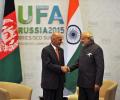
Prime Minister Narendra Modi on Friday met Afghan President Ashraf Ghani in Ufa and the two leaders are understood to have discussed Afghanistan's security situation and India's assistance in reconstruction efforts in the war-torn country.
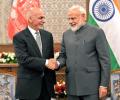
The two leaders 'shared perspectives on situation in Afghanistan, including the role played by India towards an inclusive peace process', he said.
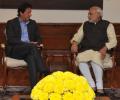
Modi would be attending the Shanghai Cooperation Organisation summit in Kyrgyzstan's capital Bishkek on June 13-14.

Prime Minister Narendra Modi arrived in Bali on Monday for the G20 Summit and bilateral meetings on its sidelines with key leaders attending this annual conference of the world's major economies.

His comments came hours after External Affairs Minister S Jaishankar arrived in the Pakistani capital to attend the Council of Heads of Government (CHG) summit of the Shanghai Cooperation Organisation.
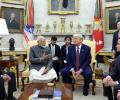
'As one former Indian diplomat put it to me, Delhi has access to the White House, but Islamabad has access to Mar-a-Lago.'

India seeks to play a supportive role for a peaceful and stable region, Prime Minister Narendra Modi said on Monday as he embarked on a high-profile visit to Russia to hold summit talks with President Vladimir Putin amid the conflict in Ukraine.

Modi's emphasises on transit for trade comes amid Pakistan's reluctance to provide such a facility for two-way trade between India and Pakistan.

Modi, in a statement before his two-day visit to Bishkek from June 13-14, said that on the sidelines of the SCO Summit, he also plans to meet several leaders, including Russian President Vladimir Putin and Chinese President Xi Jinping.

India, along with Pakistan, is set to be inducted as full members into the bloc, which mainly deals with issues relating to security and defence.

Foreign Ministers of the SCO, who met here ahead of next month's summit, said the grouping should create a bigger role for observers and dialogue partners within the SCO framework, a press release issued at the end their meeting in Beijing on Friday said.
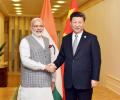
The meeting, which lasted for nearly 50-minutes, comes in the backdrop of stiff Chinese opposition to India's entry into the NSG, which looks after critical issues relating to nuclear sector, including trade and export of nuclear technology.

'We should watch -- in the near term -- for signs that the two have totally fallen out at a personal, political level.' 'Trump and Modi know how to be dealmakers, but they also know how to hold a grudge.'
Apart from emphasising the importance of India's economic development, and its re-integration into the global economy, Dr Singh has repeatedly emphasised the importance of the ideas that define the Indian civilization and the Indian Republic for global peace, security and challenges, ranging from terrorism to pandemics.
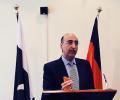
India and Pakistan should move from confrontation to cooperation, Pakistan's High Commissioner Abdul Basit on Tuesday said while adding that Prime Minister Nawaz Sharif is keen to normalise bilateral relations.

Except for Pakistan, the defence ministers of all other member countries attended the meeting in person. It is learnt that the Pakistani representative joined the deliberations virtually.

Pakistan high commission sources said it has been an usual practice to invite the Kashmiri separatist leaders on such occasions.

'If Washington has to balance Chinese power, she will have to turn to the third biggest power in the world which is India.' 'The United States and India will have to work together in order to keep Chinese ambitions in check.'

"We would take PM Modi at his words and welcome those comments when they took place. Other countries will make their own decision on engagement with Russia. We continue to coordinate with allies to mitigate impacts of war," said State Department's Principal Deputy Spokesperson Vedant Patel during a press conference on Thursday.
